Showing posts with label Bavaria. Show all posts

Sunday, May 10, 2015

Neuschwanstein Castle 5 - Tour and St. Mary's Bridge

 St. Mary's Bridge offers wonderful views of the castle - but was not accessible by shuttle since the shuttles were not operating.  The hike would have been several hours - and it just did not fit our schedule.

Views of the village of Schwangau from the Neuschwanstein Castle


Last view of the castle taken as we were leaving Fuessen to Trier

Hotel Sonne in Fuessen, Germany


We stayed at Hotel Sonne for one night on our road trip while visiting the castles of the Bavarian Kings   The hotel has quirky decor but was very well run.  Located in the old part of Fuessen which offers quite exceptional and friendly service.
Room are very comfortable and beautifully decorated and the hotel restaurant is very good indeed. We had a wonderful dinner while sitting outside.  Nice vibe!

Neuschwanstein Castle 4 - Wagner Opera themes

Ludwig was fascinated by Wagner - and decorated many of the rooms of Neuschwanstein with themes from Wagner's opera's

Sagas

The picture cycles of Neuschwanstein were inspired by the operas of Richard Wagner. The pictures were modelled on the medieval legends that the composer had also taken as the basis for his works.

Picture: Mural depicting the Sigurd saga
Sigurd
The walls of the Lower Hall are painted with scenes from the Sigurd saga.
 
Picture: Mural depicting the Gudrun saga
Gudrun
The Gudrun saga in the paintings of the Upper Hall continues on from the Sigurd saga.
 
Picture: Mural depicting the saga of Tristan and Isolde
Tristan and Isolde
In the bedroom there are scenes from Tristan and Isolde.
 
Picture: Mural depicting the Parzival saga
Parzifal
The Singers' Hall is decorated with murals illustrating the Parzifal saga.
 
Picture: Mural depicting the Lohengrin saga
Lohengrin
In the Salon the Parzival cycle is continued with the adventures of his son Lohengrin.
 
Picture: Mural depicting the Tannhäuser saga
Tannhäuser
The Study has scenes from the tragic life of the minnesinger Tannhäuser.

Neuschwanstein Castle 3 - Interior photos

Neuschwanstein
Picture: Swan motif at the door to the conservatory
Swan motif at the door to the conservatory
The picture cycles of Neuschwanstein were inspired by the operas of Richard Wagner, to whom the king dedicated the castle. The pictures were not however directly modelled on Wagner's works, but on the medieval legends that the composer had also taken as the basis for his works.
The pictures on the walls of the castle deal with love and guilt, repentance and salvation. Kings and knights, poets and lovers people the rooms. There are three main figures: the poet Tannhäuser, the swan knight Lohengrin and his father, the Grail King Parzival (Parsifal). These were Ludwig's models and kindred spirits.
A further leitmotif of the interiors is the swan. The swan was the heraldic animal of the Counts of Schwangau, whose successor the king considered himself to be. It is also the Christian symbol of the "purity" for which Ludwig strived.
Religious and political ideas were involved in the planning of the castle. This can be seen in particular in the throne hall. The paintings here show how Ludwig saw kingship "by the Grace of God": as a holy mission, with powers that the Bavarian king had never possessed.

Picture: Throne hall, apse
Throne hall, apse

 
Picture: Throne hall (detail)
 
The apartments and state rooms of the king are on the third and fourth floors. The rooms on the second floor were never finished and today house a shop, a cafeteria and a multimedia room.


Ludwig's bedroom- tells the story of the Wagner Opera Lohengrin

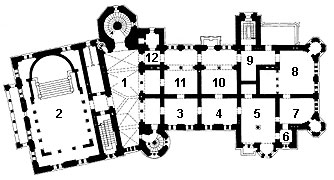
Palas / 3rd floor

Picture: Plan of the 3rd floor

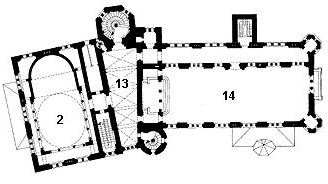
Palas / 4th floor

Picture: Plan of the 4th floor
 
After the guided tour, which ends on the 2nd floor (shop, cafeteria, multimedia-room), the historic kitchen on the ground floor can be viewed. Please note: On the page "Building history" you will find a plan of the castle complex.

Neuschwanstein Castle 2 - Mad King Ludwig

The horse drawn carriage lines were extremely long and the shuttles were not running - so it was a nice steep walk up from the valley to get to the entrance of Neuschwanstein  - But one of the finalist for the Man Made Wonders of the World could not be missed!


The castle is huge - once you actually enter through the gate.

View entering through the gate


Once through the gate - there is a staging area as you wait for your tour

An unfinished masterpiece - with bare brick rooms to this day

Neuschwanstein Castle was never finished. Construction began in around 1869, but the project was slow-moving from the start - it was originally planned to take just three years until it Ludwig could move in, but this quickly slipped to ten, then 14, then 16....
In addition, by the late 1800s, King Ludwig's castle-building projects were also running into phenomenal debt, accounting for a personal debt, in 1885, of around 14m marks. King Ludwig, however, was too stubborn (or too mad) to acknowledge these financial difficulties.
Neuschwanstein Castle The staggering view across the Alps from the inside of Neuschwanstein. Credit: Stan Hua, CC-BY-2.0.
In addition to these problems, the castle had been designed a shrine to Wagner - and a grand location for concerts of his works. Wagner died, however, in 1883, never having set foot in the site, much to the dismay of a heartbroken King Ludwig.
In 1886, King Ludwig was declared insane.
Whether or not he was truly mad is an issue for debate: it suited his court to try and depose him on grounds of mental health. After his diagnosis, he was forced to leave the castle, and, three days later, he died in extremely suspicious circumstances.
When he died in 1886, King Ludwig would only have ever seen Neuschwanstein as a building-site.
Of the 200+ planned rooms, only 14 were finished (and much of the castle remains incomplete to this day - the second-floor rooms are inaccessible to the public because they're just bare brick).
Most notably, a huge Keep was planned for the centre of the site, but, for reasons of time and finances, it has never been completed. Its foundations can still be sighted today within the castle's Upper Courtyard.
Neuschwanstein Castle The internal courtyard of Neuschwanstein looks like something from Disney. Note the stylised paintings of knights and dragons between the two turrets. Credit: Leo Seta, CC-BY-2.0.
Partially because of the vast debts incurred, just weeks after King Ludwig's death, his family opened the castle to tourists.
Building-work to complete the remainder of the exterior continued as these first tourists flocked in, and, since that time, Neuschwanstein has blossomed on the world stage as a major tourist attraction.


Neuschwanstein Castle 1


Ludwig built Neuschwanstein on the ruins of an old hunting camp of the Knights of Schwangau .  Beautifully situated with views of the mountains and the valley. 


The many towers inspired Walt Disney to build Cinderella's castle based on Newschwanstein


The Neuschwanstein Castle is one of the most visited castles in Germany and one of the most popular tourist destination in Europe.
The castle is located in Bavaria, near the town of Fussen. It was built by King Ludwig II of Bavaria, also known as the “Fairytale King”. See our Neuschwanstein Castle Tour page.
King Ludwig was a great admirer and supporter of Richard Wagner, the world – renowned composer.
Neuschwanstein Castle was built in his honor and many rooms in the castle’s interior were inspired by Wagner’s characters.
The third floor particularly reflects Ludwig’s admiration of Wagner’s operas.The Singers Hall, which occupies the entire fourth floor of Neuschwanstein also contains characters from Wagner’s operas.
Neuschwanstein literally means “New Swan Castle” referencing of “the Swan Knight” one of the Wagner’s characters.

Neuschwanstein, a fairytale castle

The Neuschwanstein Castle really looks like a fairytale castle. Neuschwanstein is a castle of the paradox. It was built in the 19th century in Bavaria, in a time when castles no longer had strategical and defensive purposes.
While Neuschwanstein’s look is that of a medieval castle, it was equiped inside with state of the art technology at that time. For example on every floor of the castle there were toilets with automatic flushing system, as well as an air heating system for the whole castle. Water was supplied by a nearby spring situated at only 200 meters above the castle.
Neuschwanstein’s positioning is also a fairytale one. It is located in the Alps in Bavaria, Germany, in a magnificent landscape, on the top of a hill. Neuschwanstein overlooks the Hohenschwangau valley. If you come to visit this castle, you will be amazed by the extremely beautiful landscape that surrounds it.
Also, Neuschwanstein lies very close to the town of Fussen, which is also a popular tourist destination in Germany.

The construction of the Neuschwanstein castle began in 1869, and originally it was projected to last three year. But Ludwig II wanted the castle to be perfect, so the immense building was not finished even at Ludwig’s death in 1886.
Neuschwanstein Castle has a very beautiful inner garden surrounded by a walled courtyard. It even has an artificial cave. Neuschwanstein’s interior is as beautiful as its outside. Though only 14 rooms were finished before Ludiwg II’s sudden death in 1886, these rooms were majestically decorated.
The two story throne room was designed in Byzantine style, with wall paintings depicting angels. Ironically, there is no throne in the Throne Room, as Ludwig died before it was completely finished.
This fairytale look of the Neuschwanstein castle inspired Walt Disney to create the Magic Kingdom. Today, Neuschwanstein is the most visited castle in Germany, and one of the most popular tourist destination in the world. Every year over 1.300.000 people crosses its gate.

Fairy Tale Castle - Hohenschwangau 2 - the Gardens

The Swan motif is very visible at Hohenschwangau


Photos from the exterior of Hohenschwangau and the gardens


The Wittelsbachs used the castle for bear hunting or as a retreat for agnatic princes. In 1743 it was plundered by Austrian troops. In the German mediatization the county of Schwangau became officially a part of the Electorate of Bavaria in 1803. King Maximilian I Joseph of Bavaria sold the castle in 1820. Only in 1832 his grandson Maximilian II of Bavaria, then crown prince, bought it back. In April 1829, he had discovered the historic site during a walking tour and reacted enthusiastically to the beauty of the surrounding area. He acquired the dilapidated building - then still known as Schwanstein - in 1832, abandoning his father's wish that he should move into the old castle (Hohes Schloss) in the nearby town of Füssen. In February 1833, the reconstruction of the castle began, continuing until 1837, with additions up to 1855. The architect in charge, Domenico Quaglio, was responsible for the neogothic style of the exterior design. He died in 1837 and the task was continued by Joseph Daniel Ohlmüller (died 1839) and Georg Friedrich Ziebland.[1] More than 90 wall paintings represent the history of Schwangau (literally translated the Swan District), as well as medieval German romances such as Parzival and the story of Lohengrin, the Knight of the Swan, on which Richard Wagner later based his operas Lohengrin of 1848 and Parsifal of 1882, sponsored by Ludwig II who had grown up with these stories at Hohenschwangau.
Hohenschwangau was the official summer and hunting residence of Maximilian, his wife Marie of Prussia, and their two sons Ludwig (the later King Ludwig II of Bavaria) and Otto (the later King Otto I of Bavaria). The young princes spent many years of their adolescence here. Queen Marie who loved to hike in the mountains created an alpine garden with plants gathered from all over the alps. The King and the Queen lived in the main building, and the boys in the annex. The Queen's cousin, Frederick William IV of Prussia, had Stolzenfels Castle on the Rhine rebuilt at the same time in the Gothic Revival style.

Views of the valley taken from Hohenschwangau

Fairy Tale Castles - Hohenschwangu 2

Whittelsbach Dynasty - 900 years ruling in Bavaria.  We are staying in Fussen, Germany to visit the Fairy Tale Castle

Knights of Schwangau - the Swan - date from 12th century.  Maximilian II built Hohenschwangu.  And this was the summer home of Ludwig II.  Ludwig was born at Nymphenburg Palace in Munich - covered in an earlier post on this blog.

First glimpse of the Hohenschwangu Castle - childhood home of Mad King Ludwig


And our first glimpse of Neuschwanstein

The village shops and store

Hohenschwangu


History of the castle


Hohenschwangau Castle was mentioned the first time in records of the 12th century.
Until the 16th century its owners were the knights of Schwangau. During the following time it changed hands a couple of times and was partially destroyed during different wars.
In 1832 the later King Maximilian II., father of King Ludwig II., acquired the ruin and had the castle rebuilt according to original plans. After its completion it used to be the summer and hunting residence of the Bavarian royal family. In his whole life, the famous Bavarian King Ludwig II. spent a few weeks each summer in Hohenschwangau.
Since 1928 the Wilttelsbacher Ausgleichsfonds owns Hohenschwangau Castle.


The hall of the heroes


The largest room in Hohenschwangau Castle is the banquet hall, which is also called “the hall of the heroes”. The paintings show different scenes of the Wilkina Saga and its hero Dietrich von Bern.


The Queens bedroom


The “oriental room” used to be the bedroom of Queen Mary, the mother of King Ludwig II. King Maximilian II had this room furnished after his return of his journey through Turkey and Greece in 1832/1833.


The Hohenstaufen-Room


»Hohenstaufen Room«  

The “Hohenstaufen-Room” served King Maximilian II. and King Ludwig II. as dressing room. But it was King Ludwig II. music room as well. The piano, which is to be seen in here, was probably the one, the famous composer Richard Wagner used to play, when he visited Hohenschwangau Castle.


The Kings bedroom


  »Tasso Room«

The "Tasso-Room" was the bedroom of the kings. King Ludwig II. had something extraordinary installed in this room. There is a starry sky with illuminatable stars and moon, integrated in the ceiling.


The "Berchta"-room


The "Berchta-Room" was the writing room of Queen Mary. Surrounded by beautiful panted ornaments, the murals tell the Bavarian version of the legend about the birth of Charlemagne.


Views of the German Alps - from Schwangu


We walked up the hill from the village to visit Hohenschwangu.
The town of Schwangau - mainly shops and restaurants in the valley below the castles