
Swan motif at the door to the conservatory
The picture cycles of Neuschwanstein were inspired by the operas of Richard Wagner, to whom the king dedicated the castle. The pictures were not however directly modelled on Wagner's works, but on the medieval legends that the composer had also taken as the basis for his works. The pictures on the walls of the castle deal with love and guilt, repentance and salvation. Kings and knights, poets and lovers people the rooms. There are three main figures: the poet Tannhäuser, the swan knight Lohengrin and his father, the Grail King Parzival (Parsifal). These were Ludwig's models and kindred spirits.
A further leitmotif of the interiors is the swan. The swan was the heraldic animal of the Counts of Schwangau, whose successor the king considered himself to be. It is also the Christian symbol of the "purity" for which Ludwig strived.
Religious and political ideas were involved in the planning of the castle. This can be seen in particular in the throne hall. The paintings here show how Ludwig saw kingship "by the Grace of God": as a holy mission, with powers that the Bavarian king had never possessed.

Throne hall, apse


 |
| Ludwig's bedroom- tells the story of the Wagner Opera Lohengrin |

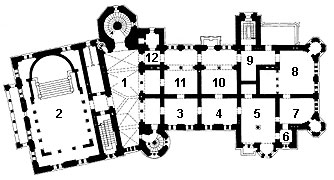
Palas / 3rd floor
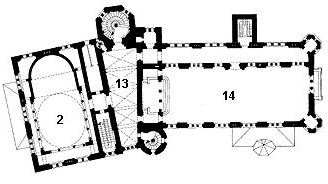
Palas / 4th floor
1 Lower Hall
2 Throne Hall
3 Anteroom (no picture)
4 Dining room
5 Bedroom
6 Oratory
7 Dressing room
2 Throne Hall
3 Anteroom (no picture)
4 Dining room
5 Bedroom
6 Oratory
7 Dressing room

No comments:
Post a Comment